

AMD vs. Intel: The Evolution of CPU Gaming Performance
After looking at the concluding few generations of Intel and AMD CPUs separately, here'south our terminal installment in the gaming performance progress series. In this commodity nosotros'll be comparing a decade of AMD and Intel CPUs head to head.
For those of yous who missed the first few articles, this all began with a look at Intel'southward tenth generation Core CPUs, where we tested Core i3, i5, i7 and i9 models at the same clock speed and with the same number of cores active. This gave u.s.a. a clear and very interesting look at how L3 enshroud capacity influences gaming operation, and we establish that for today's games Intel often sees its biggest performance uplifts when increasing the L3 cache capacity, rather than adding more cores.

By limiting all CPUs to just 4 active cores with 8 threads at the same clock frequency, we got a really adept look at stuff that hasn't been tested before, and that led to comparisons with older Intel CPUs.
Naturally, the next pace was to do the aforementioned with a range of AMD processors while normalizing the core count and clock frequency. This exposed only how weak the old FX series was, and the huge bound AMD has made with each successive Ryzen generation.

This CPU compages criterion was an interesting way of looking at the progress both companies accept fabricated. At present all that was left for us to practise was examination a few more CPU generations that were missing from previous articles such as Sandy Bridge, Ivy Bridge, Haswell, and of course, Rocket Lake, and throw all the data together.
So for this test, all CPUs were clocked at iv.two GHz with the exception of the Ryzen 7 1800X which but clocked to 4.1 GHz, but that'south merely a 2.5% frequency discrepancy that won't influence results in a meaningful fashion. Models using DDR4 memory were paired with DDR4-3200 CL14 and DDR3 models used DD3-2400 CL11 memory. Other than that everything is as apples to apples as possible with every model running with 4 agile cores.

Delight note no cores were disabled on the FX-8350, so if you believe information technology'southward an 8-core CPU then I guess viii cores were active. Whatever the case, it's either a deadening quad-core or a beyond terrible 8-cadre processor, we'll leave that for you to decide. Throughout our gaming tests we used the Radeon RX 6900 XT. Permit's dig into the data...
Benchmarks
Starting with Rainbow 6 Siege results, we see that when comparing the 2022 options -- AMD Piledriver and Intel Ivy Span architectures -- nosotros run across that Intel delivered 21% better frame rates and a 29% stronger one% depression, which was a significant reward and as a consequence AMD was forced to sell their parts at a much lower price. That actually stung considering the FX dies were nigh twice the size at 315mm2, and every bit a result were likewise significantly more power hungry.
From Ivy Bridge to Haswell we're looking at a very strong 23% performance uplift and I don't recall seeing margins that big back in 2022, only of grade, games weren't equally demanding at the time and GPUs weren't nearly equally powerful. In fact, information technology was extremely hard to highlight the benefits of SMT technology for games.
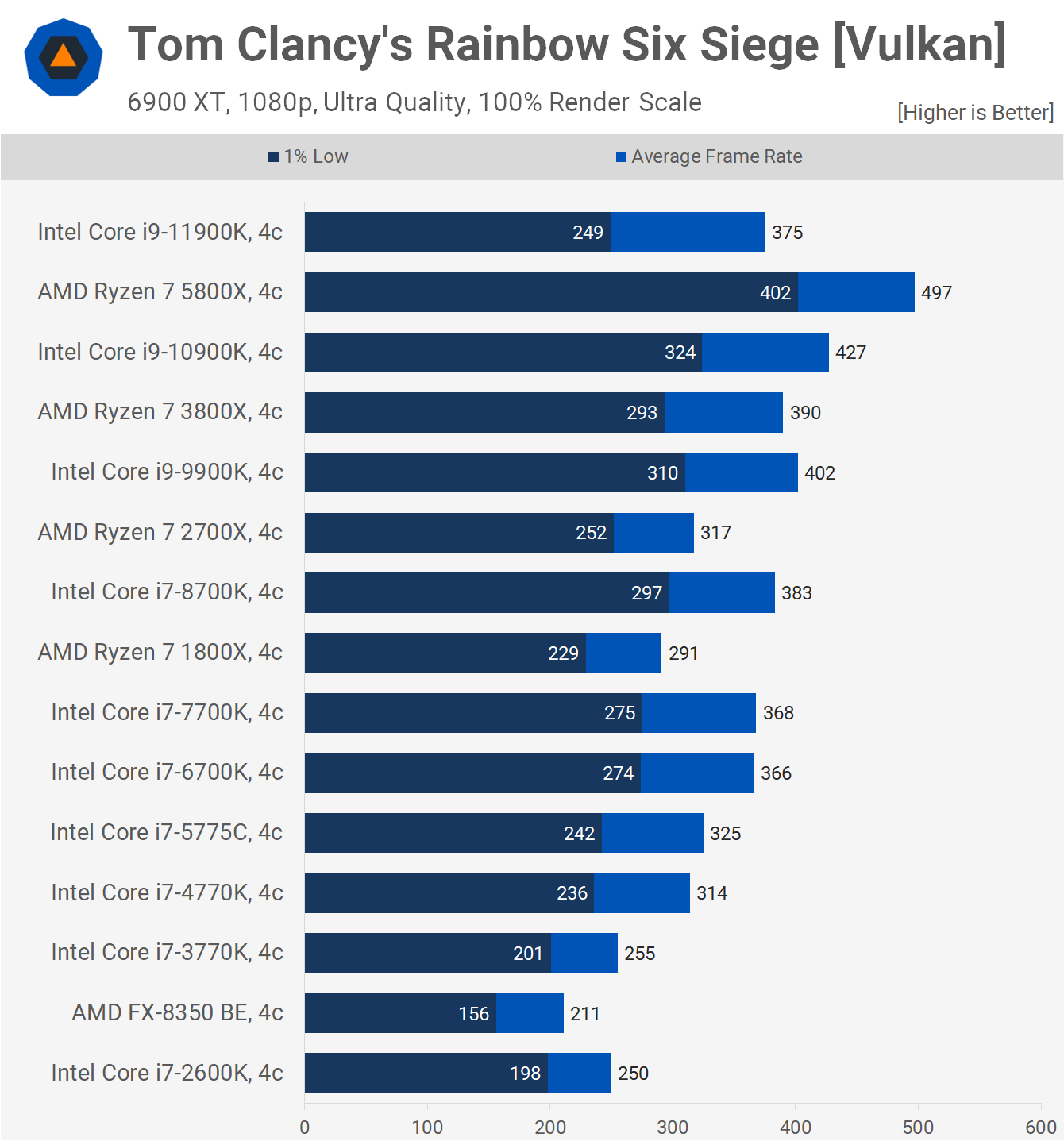
By 2022 though things were getting dire for AMD as they were competing with Haswell and clock-for-clock Intel was ahead by almost 50%, at least in this kind of games. Broadwell with its eDRAM doesn't offering much over Haswell, a pocket-sized 4% gain which is zippo to write habitation about. In 2022 we besides received Intel's Skylake compages and by this point virtually no ane even uttered the name 'AMD' when discussing CPUs. That's because everything else beingness equal, Intel was offering 73% greater gaming functioning in RSS.
This is where things first to stagnate for Intel. From Skylake to Kaby Lake nosotros run across their smallest performance gain in generations. Basically zip was gained from the 6700K to the 7700K.
Then as we discovered recently, since Skylake the cardinal source of improved gaming performance past Intel has been to increase the L3 cache capacity. This starts with the 8700K which jumps upwards from the 7700K'southward 8MB L3 enshroud to 12MB and this results in a minor 4% performance heave in Rainbow Six Siege. Then Intel upgraded to a 16MB L3 cache with the 9900K and although the core count and clock frequency remained the aforementioned at 4.ii GHz, the frame rate was increased by a further v%.
Of form, while Intel was stuck with what was essentially Skylake but with more than cores and cache, AMD saw room to make its reappearance. Ryzen was unleashed for the first fourth dimension in 2022, five years afterward the FX-8350. The get-go generation architecture was almost 40% faster when compared to the FX series in Rainbow Six Siege.
Only as impressive as that gain was, AMD was withal miles behind Intel when information technology came to gaming performance. In this case, they roughly caught upwardly to Haswell, where Intel was dorsum in 2022. Ryzen appealed to enthusiasts every bit information technology offered more cores and as such was a productivity beast. So although the gaming functioning wasn't exactly impressive, information technology was decent and there were other positives on offering which helped make the series a success and a step in the right management for AMD.
As Intel added two more cores with Coffee Lake, AMD needed to printing forwards and they did that with Zen+. Hither the 2700X offered a decent 9% comeback -- withal 17% slower than Intel's 2022 architecture -- merely the gap was slowly endmost. In 2022 things really heated upwardly when AMD launched Zen 2 and they were no longer on Intel's heels with the 3800X trailing the 9900K by just five to 10%.
With the 2022 release of Zen 3 the fourth dimension finally came where AMD could surpass Intel in gaming performance and give the final decease blow to the 14nm procedure. Clock for clock AMD was now 16% faster, and of course, Zen 3 did clock very well, so for the most function AMD was at present faster for gaming. Intel tried to lessen the blow with Rocket Lake and while some gains were made, in some instances like what we see here, Intel took a step backwards.
That was a long wait at the Rainbow 6 Siege results, so we'll summarize some of the following games...

Assassin'south Creed Valhalla provides u.s. with far less interesting data as this one is more often than not GPU limited and doesn't brand good utilize of the CPU. Intel capped out with the introduction of Skylake and AMD never managed to catch them, but if we look back to 2022 where Intel was up to 56% faster, today that margin is just vii% in Intel favor, at least when matched clock-for-clock at the same core count.
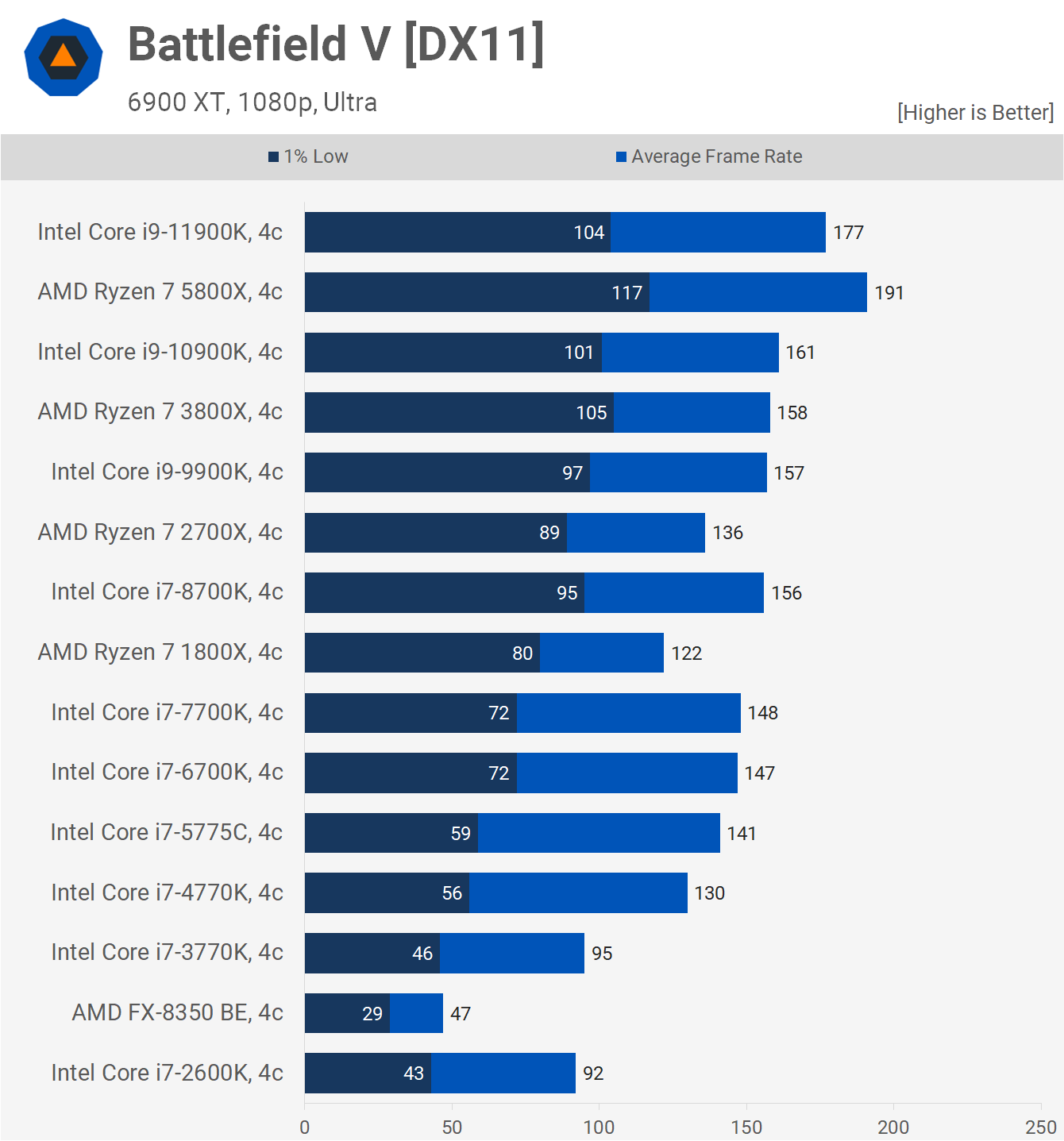
Battlefield V was brutal on the AMD FX-8350. Here information technology managed just 47 fps on average while the 3770K was good for 95 fps, a 102% performance increase from Intel in 2022. If that wasn't bad enough Intel achieved a 37% increase with Haswell, jumping upwardly to 130 fps on boilerplate, nearly an 180% increment from the FX-8350. From Haswell to Broadwell nosotros see a modest 8% increase and and so from Broadwell to Skylake a 4% increase, while Kaby Lake offered nothing new.
After Ryzen arrived, we're looking at Haswell-similar operation, though that's not entirely accurate. While the average frame rates are a shut match, the 1% low performance of Ryzen was nearly 30% better. AMD then achieved an eleven% increase from Zen to Zen+ while Intel boosted clock to clock performance by 5% by increasing the L3 cache capacity of their Cadre i7 range.
Again, it was Zen ii where AMD brought real pressure, boosting performance past sixteen% which was plenty to match Intel at the same core count and clock frequency in this game.
Intel did see a performance uplift with their 11th generation, jumping up to 177 fps on average which is a 10% boost. Despite that improvement, AMD is still out in front with Zen 3, offering eight% more performance on average. This ways from 2022, Intel has accomplished a performance improvement of twenty% while AMD almost tripled that with a 57% improvement from Zen to Zen three.
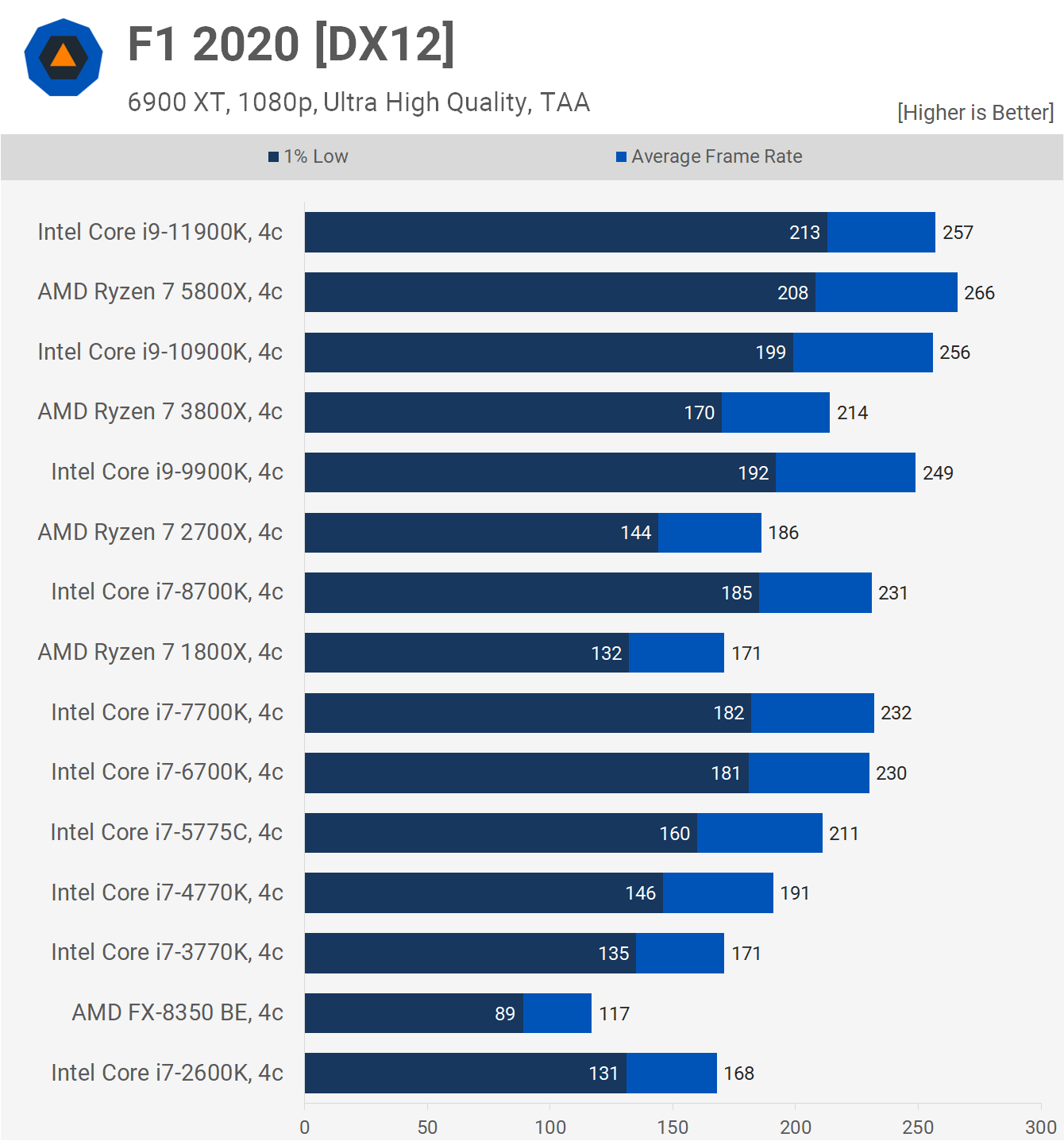
F1 2022 isn't as hard on the CPU as Battlefield 5, just even so we run into strong gains across most of CPU generations. The 2022 match up sees Intel able to evangelize 46% greater performance with Ivy Span when compared to Piledriver. Then from Ivy Bridge to Haswell we see a modest 12% increase and this time Broadwell offered a 10% boost over Haswell, so for a few years Intel was managing to eke out some decent gains on the 14nm process without adding more than cores.
That came to a screeching halt with Skylake, and nosotros see no real change from the 6700K to the 8700K, which was a trouble for Intel as AMD started to strike back with Ryzen.
Ryzen wasn't exactly amazing out of the gate with the 1800X only able to lucifer the five-year-old 3770K. Zen+ gets AMD upwards to speed with Haswell or thereabouts, and Zen 2 puts them on par with Broadwell and not a great bargain behind Skylake through to Coffee Lake. A massive boost is seen with Zen iii to finally hit the pb, even against the more than contempo Rocket Lake compages.

Hitman 2 shows an eleven% performance increase from Sandy Bridge to Ivy Bridge which isn't something we run into often, though I wonder how much of this is down to the deviation in PCI Express bandwidth given we're comparing PCIe 2.0 vs 3.0. Whatever the example, it means in 2022 Intel's architecture offered 33% more performance in this championship.
And so from 2022 to 2022 Intel managed to meliorate operation by a whopping 38% and that meant their lead over AMD was blown out to 84%. As we've seen a number of times at present, Intel managed reasonable performance gains from Haswell to Broadwell to Skylake, and that'south where things slowed considerably for the Blue Team. Information technology wasn't until the 11th-gen that Intel managed a solid performance uplift and in this example it was enough to beat AMD'south Zen three.
But well before the inflow of Zen 3, AMD had to make do with start generation Zen and hither they were still slower than Intel'south 5 twelvemonth former Haswell architecture. Zen+ did get them on par with Haswell and Zen two pushed them up to Skylake, which meant they were competitive with Coffee Lake.

Horizon Nix Dawn performance on Intel CPUs is very similar to that of Assassinator'due south Creed Valhalla in the sense that they were able to max this one out with Skylake. AMD, on the other manus, took until Zen 3 to go there. AMD improved performance by just over 50% from 2022 to 2022, while Intel didn't motion only they were already out in forepart.
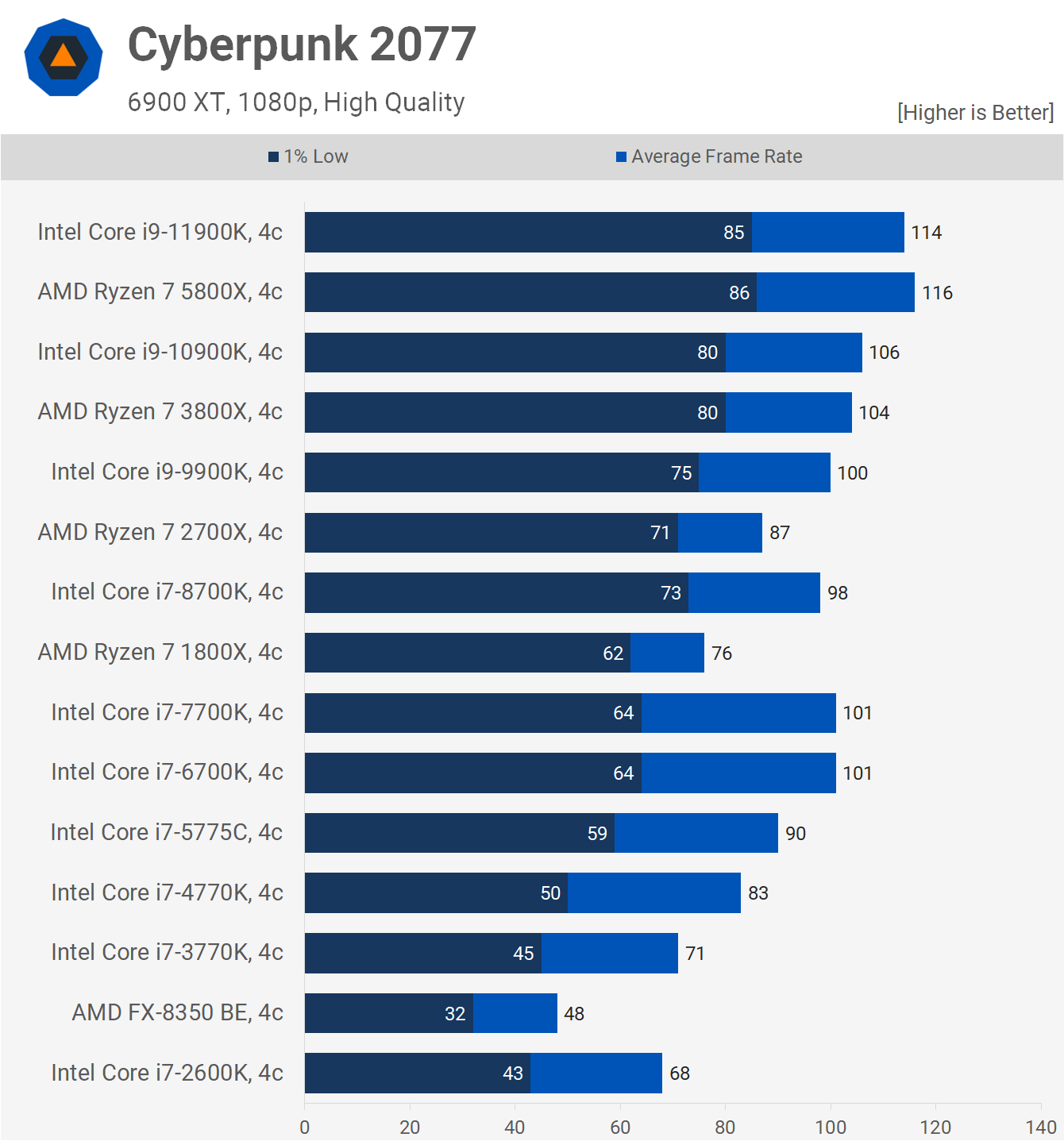
The Cyberpunk 2077 results don't look that dissimilar to other CPU demanding games we've checked out then far. In 2022 Intel enjoyed a 48% architectural performance reward and by 2022 that margin more than doubled to 110% with Skylake. This is why the AMD FX series was such a disaster for the visitor. Aware that it was a complete failure, they were forced to shift gears with a fundamental redesign and that took time.
So starting in 2022, information technology took five years before we would meet another flagship CPU from AMD, and in that time they were forced to do boxing with Intel who in this example had a 110% architectural advantage while using one-half equally much power, brutal stuff.
What we tin also see here is Intel's steady refinement of their 14nm process upward until Skylake. From Sandy Bridge to Skylake, Intel found about fifty% more performance over a 4 year catamenia which is remarkable. However, from Skylake to Rocket Lake which is a 6 year gap, they constitute just xiii% more performance when not calculation cores and running at the same clock speed.

Shadow of the Tomb Raider shows u.s.a. how Intel enjoyed the benefits of a significantly more efficient compages nearly 10 years ago, delivering 32% more than performance at the same frequency. And so from Ivy Bridge to Haswell we run across a farther 23% increase for Intel and from Haswell to Broadwell a xiii% increment. Then things start to slow downward, Skylake was just five% faster than Broadwell, and that means from the 6th generation to the 10th Intel additional operation by just 11%.
Nosotros as well come across AMD shadowing Haswell with Zen and and then matching it with Zen+. But by the time Zen 2 arrived AMD were up to speed and then they raced ahead with Zen iii, though Intel did catch them upward a little with Rocket Lake.

Sentry Dogs Legion provides us with some other practiced example of Intel stagnation over the last 6 years, essentially hitting a brick wall with Skylake, though they recently overcame that with Rocket Lake. As earlier, we can see how brutal pre-2017 was for AMD, bravado a margin in the 95% range with Haswell and AMD wouldn't be able to match that level of performance until 2022 with Zen.
Performance Summary
All the information we've gathered provides real insight into how AMD and Intel CPU architectures compared over the past decade for gaming. We've seen AMD come from nowhere to often beating Intel, while the latter has made smaller steps in pure architecture terms in the final five to half-dozen years. Let's take now look at the 9 game average...
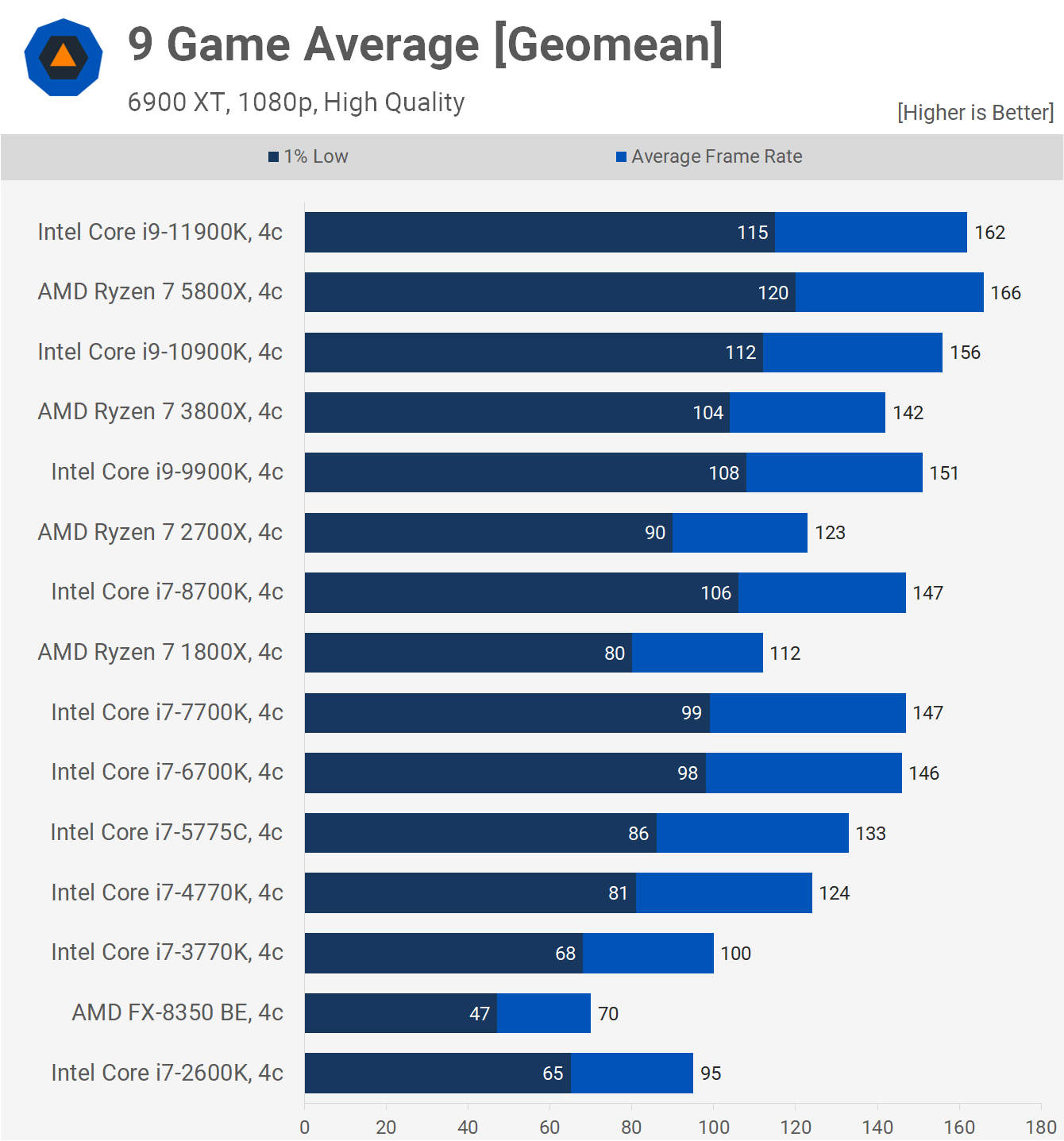
Dorsum in 2022 Intel was ahead by a 43% margin on average when comparison the FX-8350 and Core i7-3770K at the same clock frequency. That's a massive difference, compounded by the fact that AMD consumed significantly more ability at the fourth dimension.
But if but that was a worst case scenario for AMD. Just a year later Intel extended that margin to 77% and by 2022 they were 110% alee.
Technically, the 6700K wasn't even Intel'southward flagship desktop role in 2022, that honour goes to the Core i7-5960X and its 20MB L3 cache, but that's a dissimilar story. Given that massive performance discrepancy, AMD was forced to slash pricing from the $195 introductory price in 2022 to merely $120 in 2022, with some sales seeing the flake drop equally low as $90. That would be like AMD having to sell a part like the 5800X at less than $200 today.
Clearly, AMD was able to plough effectually this state of affairs years later. And although Zen wasn't a gaming monster in 2022, it was good enough to improve upon those foundations. Zen+ continued that trend in 2022 and by 2022 AMD was bully Intel'south desktop CPU sales.
What We Learned
As we wrap up this interesting look at the architectural performance differences for gaming between AMD and Intel over the past decade, this evolution conspicuously highlights why our reviews have been by and large positive towards AMD Ryzen processors from 2022 onwards, and why they were then pro-Intel prior to 2022.
Information technology was extremely hard to recommend AMD CPUs for PC gaming back in the FX days. The arrival of Ryzen marked a turning betoken, and while I wasn't completely sold on the outset generation, at to the lowest degree for gaming, in that location were plenty of scenarios where you could recommend them.

Based on this data, you tin see why Zen+ started to shift things in AMD'southward favor. They were still well down on Intel for gaming when CPU express, but a lot of the fourth dimension games aren't CPU express, and not all gamers want to but play games. This made Ryzen a desirable and well rounded solution that was besides price effective.

With Intel and AMD now evenly matched in terms of gaming performance -- AMD does concur a meaning efficiency reward, which is funny looking back at 2022 -- we can't await to run into what the next generation of hardware brings.
There's a ton of hope backside Intel's 12th generation Alder Lake CPUs which are arriving very soon and are expected to bring big changes, which should be very exciting for prospective buyers and the overall marketplace. Make certain you lot stick around for that as nosotros plan to review the new fries when fourth dimension comes.
Shopping Shortcuts:
- AMD Ryzen v 5600X on Amazon
- AMD Ryzen 7 5800X on Amazon
- AMD Ryzen 9 5900X on Amazon
- Intel Core i5-11600K on Amazon
- Intel Core i7-11700 on Amazon
- Intel Cadre i9-11900 on Amazon

Source: https://www.techspot.com/review/2337-intel-vs-amd-gaming-performance-evolution/
Posted by: blountthatermonlen.blogspot.com
0 Response to "AMD vs. Intel: The Evolution of CPU Gaming Performance"
Post a Comment